Get IRS W-2 Form
Every year, as the calendar turns to the end of January, employers across the United States embark on a crucial task: distributing W-2 forms to their employees. This document is not just a piece of paper; it is a comprehensive record that outlines an employee's annual wages and the taxes withheld from those earnings. For both employees and the Internal Revenue Service (IRS), the W-2 form serves as a foundational piece in the puzzle of tax filing. It ensures that individuals can accurately report their income and pay the correct amount of taxes, while also allowing the IRS to verify that information. Beyond wages and taxes, the W-2 form includes details about retirement plan contributions, social security earnings, and other pertinent tax information. Its importance cannot be understated, acting as a key player in making sure the tax process operates smoothly for millions of people in the U.S.
IRS W-2 Example

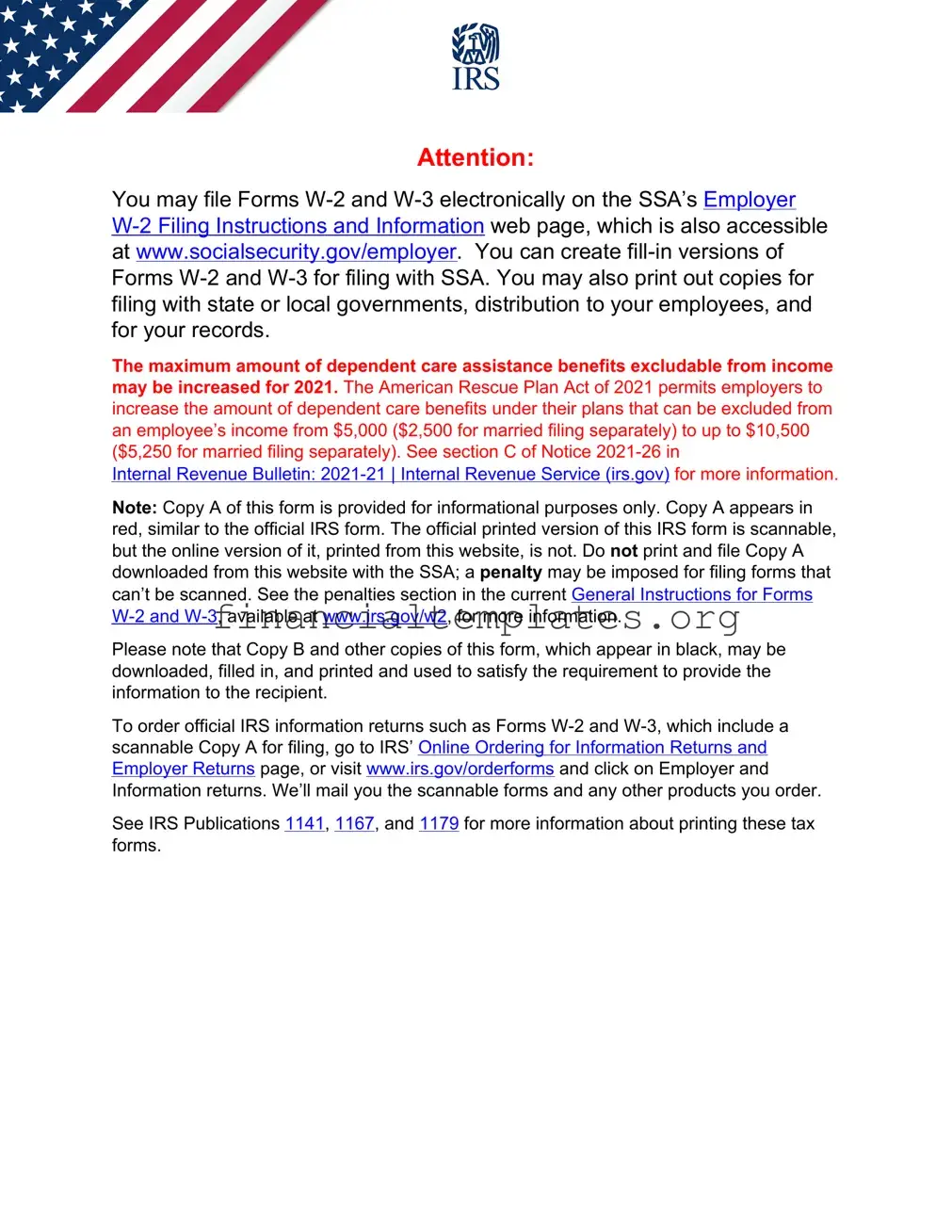
Attention:
You may file Forms
The maximum amount of dependent care assistance benefits excludable from income may be increased for 2021. The American Rescue Plan Act of 2021 permits employers to increase the amount of dependent care benefits under their plans that can be excluded from an employee’s income from $5,000 ($2,500 for married filing separately) to up to $10,500 ($5,250 for married filing separately). See section C of Notice
Internal Revenue Bulletin:
Note: Copy A of this form is provided for informational purposes only. Copy A appears in red, similar to the official IRS form. The official printed version of this IRS form is scannable, but the online version of it, printed from this website, is not. Do not print and file Copy A downloaded from this website with the SSA; a penalty may be imposed for filing forms that can’t be scanned. See the penalties section in the current General Instructions for Forms
Please note that Copy B and other copies of this form, which appear in black, may be downloaded, filled in, and printed and used to satisfy the requirement to provide the information to the recipient.
To order official IRS information returns such as Forms
See IRS Publications 1141, 1167, and 1179 for more information about printing these tax forms.

|
|
|
|
|
|
|
|
|
|
|
|
|
|
|
|
|
|
|
|
|
|
|
|
|
|
|
|
|
22222 |
VOID |
|
|
a |
Employee’s social security number |
For Official Use Only ▶ |
|
|
|
|
|
|
|
|
|
|
|
|
||||||||
|
|
|
|
|
|
|
|
|
|
|
|
|
|
||||||||||||||
|
|
|
|
|
|
|
OMB No. |
|
|
|
|
|
|
|
|
|
|
|
|
||||||||
|
|
|
|
|
|
|
|
|
|
|
|
|
|
|
|
|
|
|
|
|
|
|
|||||
|
|
|
|
|
|
|
|
|
|
|
|
|
|
|
|
|
|
|
|
|
|
|
|
|
|
||
|
b Employer identification number (EIN) |
|
|
|
|
|
1 Wages, tips, other compensation |
|
2 Federal income tax withheld |
|
|||||||||||||||||
|
|
|
|
|
|
|
|
|
|
|
|
|
|
|
|
|
|
|
|||||||||
|
c Employer’s name, address, and ZIP code |
|
3 |
Social security wages |
|
|
|
4 Social security tax withheld |
|
||||||||||||||||||
|
|
|
|
|
|
|
|
|
|
|
|
|
|
|
|
|
|
|
|
|
|
|
|
|
|
|
|
|
|
|
|
|
|
|
|
|
|
|
|
|
5 Medicare wages and tips |
|
6 |
Medicare tax withheld |
|
||||||||||
|
|
|
|
|
|
|
|
|
|
|
|
|
|
|
|
|
|
|
|
|
|
|
|
|
|
|
|
|
|
|
|
|
|
|
|
|
|
|
|
7 |
Social security tips |
|
|
|
8 |
Allocated tips |
|
|
|
|
|||||
|
|
|
|
|
|
|
|
|
|
|
|
|
|
|
|
|
|
|
|
|
|
|
|
|
|
||
|
d Control number |
|
|
|
|
|
|
|
|
9 |
|
|
|
|
|
|
|
10 |
Dependent care benefits |
|
|||||||
|
|
|
|
|
|
|
|
|
|
|
|
|
|
|
|
|
|
|
|
|
|
||||||
|
|
|
|
|
|
|
|
|
|
|
|
|
|
|
|
|
|
|
|
|
|
|
|
|
|
|
|
|
e Employee’s first name and initial |
|
Last name |
|
Suff. |
11 |
Nonqualified plans |
|
|
|
12a See instructions for box 12 |
|
|||||||||||||||
|
|
|
|
|
|
|
|
|
|
|
|
|
|
|
|
|
|
|
|
|
C |
|
|
|
|
|
|
|
|
|
|
|
|
|
|
|
|
|
|
|
|
|
|
|
|
|
|
|
o |
|
|
|
|
|
|
|
|
|
|
|
|
|
|
|
|
|
|
|
|
|
|
|
|
|
|
|
d |
|
|
|
|
|
|
|
|
|
|
|
|
|
|
|
|
|
|
|
|
|
|
|
|
|
|
|
e |
|
|
|
|
|
|
|
|
|
|
|
|
|
|
|
|
|
|
|
13 |
Statutory |
Retirement |
|
12b |
|
|
|
|
|
|
||||
|
|
|
|
|
|
|
|
|
|
|
|
|
|
employee |
plan |
sick pay |
|
C |
|
|
|
|
|
|
|||
|
|
|
|
|
|
|
|
|
|
|
|
|
|
|
|
|
|
|
|
|
o |
|
|
|
|
|
|
|
|
|
|
|
|
|
|
|
|
|
|
|
|
|
|
|
|
|
|
|
d |
|
|
|
|
|
|
|
|
|
|
|
|
|
|
|
|
|
|
|
|
|
|
|
|
|
|
|
e |
|
|
|
|
|
|
|
|
|
|
|
|
|
|
|
|
|
|
|
|
|
|
|
|
|
|
|
|
|
|
|
|
|
|
|
|
|
|
|
|
|
|
|
|
|
|
|
14 Other |
|
|
|
|
|
12c |
|
|
|
|
|
|
||
|
|
|
|
|
|
|
|
|
|
|
|
|
|
|
|
|
|
|
|
|
C |
|
|
|
|
|
|
|
|
|
|
|
|
|
|
|
|
|
|
|
|
|
|
|
|
|
|
|
o |
|
|
|
|
|
|
|
|
|
|
|
|
|
|
|
|
|
|
|
|
|
|
|
|
|
|
|
d |
|
|
|
|
|
|
|
|
|
|
|
|
|
|
|
|
|
|
|
|
|
|
|
|
|
|
|
e |
|
|
|
|
|
|
|
|
|
|
|
|
|
|
|
|
|
|
|
|
|
|
|
|
|
|
|
12d |
|
|
|
|
|
|
|
|
|
|
|
|
|
|
|
|
|
|
|
|
|
|
|
|
|
|
|
C |
|
|
|
|
|
|
|
|
|
|
|
|
|
|
|
|
|
|
|
|
|
|
|
|
|
|
|
o |
|
|
|
|
|
|
|
|
|
|
|
|
|
|
|
|
|
|
|
|
|
|
|
|
|
|
|
d |
|
|
|
|
|
|
|
|
|
|
|
|
|
|
|
|
|
|
|
|
|
|
|
|
|
|
|
e |
|
|
|
|
|
|
|
f Employee’s address and ZIP code |
|
|
|
|
|
|
|
|
|
|
|
|
|
|
|
|
|
|
|
|
||||||
|
15 State Employer’s state ID number |
|
|
16 State wages, tips, etc. |
17 State income tax |
|
18 Local wages, tips, etc. |
19 Local income tax |
|
20 Locality name |
|
||||||||||||||||
|
|
|
|
|
|
|
|
|
|
|
|
|
|
|
|
|
|
|
|
|
|
|
|
|
|
||
|
|
|
|
|
|
|
|
|
|
|
|
|
|
|
|
|
|
|
|
|
|
|
|
|
|
|
|
|
|
|
|
|
|
|
|
|
|
|
|
|
|
|
|
|
|
|
|
|
|
|
|
|
|
|
|
|
|
|
|
|
|
|
|
|
|
|
|
|
|
|
|
|
|
|
|
|
|
|
|
|
|
|
|
|
|
|
|
|
|
|
|
|
|
|
|
|
|
|
|
|
|
|
|
|
|
|
|
|
|
|
|
|
|
|
|
|
|
|
|
|
|
|
|
|
|
|
|
|
|
|
|
|
|
|
|
|
|
|
|
|
Form |
2022 |
|
|
Department of the |
||||||||||||||||||||||
|
|
|
|
|
For Privacy Act and Paperwork Reduction |
||||||||||||||||||||||
|
Copy |
|
|
|
|
|
Act Notice, see the separate instructions. |
||||||||||||||||||||
|
|
|
|
|
|
|
|
|
|
|
|
|
|
|
|||||||||||||
|
Form |
|
|
|
|
|
|
|
|
|
|
Cat. No. 10134D |
|||||||||||||||
Do Not Cut, Fold, or Staple Forms on This Page

22222 |
a Employee’s social security number |
|
|
|
|
|
|
|
|
|
|
|
|
|
|||
|
|
|
OMB No. |
|
|
|
|
|
|
|
|
|
|||||
|
|
|
|
|
|
|
|
|
|
|
|
|
|
||||
|
|
|
|
|
|
|
|
|
|
|
|
|
|
|
|
|
|
b Employer identification number (EIN) |
|
|
|
1 Wages, tips, other compensation |
|
2 Federal income tax withheld |
|||||||||||
|
|
|
|
|
|
|
|
|
|
|
|
|
|
|
|||
c Employer’s name, address, and ZIP code |
|
3 |
Social security wages |
|
|
|
4 Social security tax withheld |
||||||||||
|
|
|
|
|
|
|
|
|
|
|
|
|
|
|
|
|
|
|
|
|
|
|
|
5 Medicare wages and tips |
|
6 |
Medicare tax withheld |
||||||||
|
|
|
|
|
|
|
|
|
|
|
|
|
|
|
|
|
|
|
|
|
|
|
|
7 |
Social security tips |
|
|
|
8 |
Allocated tips |
|
||||
|
|
|
|
|
|
|
|
|
|
|
|
|
|
|
|
|
|
d Control number |
|
|
|
9 |
|
|
|
|
|
|
|
10 |
Dependent care benefits |
||||
|
|
|
|
|
|
|
|
|
|
|
|
|
|
|
|
|
|
|
|
|
|
|
|
|
|
|
|
|
|
|
|
|
|
|
|
e Employee’s first name and initial |
Last name |
Suff. |
11 |
Nonqualified plans |
|
|
|
12a |
|
|
|
||||||
|
|
|
|
|
|
|
|
|
|
|
|
|
|
C |
|
|
|
|
|
|
|
|
|
|
|
|
|
|
|
|
|
o |
|
|
|
|
|
|
|
|
|
|
|
|
|
|
|
|
|
d |
|
|
|
|
|
|
|
|
|
|
|
|
|
|
|
|
|
e |
|
|
|
|
|
|
|
|
|
13 |
Statutory |
Retirement |
|
12b |
|
|
|
||||
|
|
|
|
|
|
|
employee |
plan |
sick pay |
|
C |
|
|
|
|||
|
|
|
|
|
|
|
|
|
|
|
|
|
|
o |
|
|
|
|
|
|
|
|
|
|
|
|
|
|
|
|
|
d |
|
|
|
|
|
|
|
|
|
|
|
|
|
|
|
|
|
e |
|
|
|
|
|
|
|
|
|
|
|
|
|
|
|
|
|
|
|
|
|
|
|
|
|
|
|
14 Other |
|
|
|
|
|
12c |
|
|
|
||
|
|
|
|
|
|
|
|
|
|
|
|
|
|
C |
|
|
|
|
|
|
|
|
|
|
|
|
|
|
|
|
|
o |
|
|
|
|
|
|
|
|
|
|
|
|
|
|
|
|
|
d |
|
|
|
|
|
|
|
|
|
|
|
|
|
|
|
|
|
e |
|
|
|
|
|
|
|
|
|
|
|
|
|
|
|
|
|
12d |
|
|
|
|
|
|
|
|
|
|
|
|
|
|
|
|
|
C |
|
|
|
|
|
|
|
|
|
|
|
|
|
|
|
|
|
o |
|
|
|
|
|
|
|
|
|
|
|
|
|
|
|
|
|
d |
|
|
|
|
|
|
|
|
|
|
|
|
|
|
|
|
|
e |
|
|
|
f Employee’s address and ZIP code |
|
|
|
|
|
|
|
|
|
|
|
|
|
|
|
||
15 State Employer’s state ID number |
|
16 State wages, tips, etc. |
17 State income tax |
|
18 Local wages, tips, etc. |
19 Local income tax |
20 Locality name |
||||||||||
|
|
|
|
|
|
|
|
|
|
|
|
|
|
|
|
|
|
|
|
|
|
|
|
|
|
|
|
|
|
|
|
|
|
|
|
|
|
|
|
|
|
|
|
|
|
|
|
|
|
|
|
|
|
|
|
|
|
|
|
|
|
|
|
|
|
|
|
|
|
|
|
Form |
2022 |
|
|
Department of the |
|||||||||||||
|
|
|
|
|
|
|
|
|
|
||||||||
Copy

|
|
a |
Employee’s social security number |
|
|
|
Safe, accurate, |
|
|
|
|
|
Visit the IRS website at |
|
|||||
|
|
|
|
|
OMB No. |
FAST! Use |
|
|
|
|
|
www.irs.gov/efile |
|
||||||
|
|
|
|
|
|
|
|
|
|
||||||||||
|
|
|
|
|
|
|
|
|
|
|
|
|
|
|
|
|
|||
|
|
|
|
|
|
|
|
|
|
|
|
|
|
|
|
|
|
||
b Employer identification number (EIN) |
|
|
|
1 Wages, tips, other compensation |
|
2 Federal income tax withheld |
|
||||||||||||
|
|
|
|
|
|
|
|
|
|
|
|
|
|
|
|
||||
c Employer’s name, address, and ZIP code |
|
3 |
Social security wages |
|
|
|
4 Social security tax withheld |
||||||||||||
|
|
|
|
|
|
|
|
|
|
|
|
|
|
|
|
|
|
||
|
|
|
|
|
|
5 Medicare wages and tips |
|
6 |
Medicare tax withheld |
||||||||||
|
|
|
|
|
|
|
|
|
|
|
|
|
|
|
|
|
|
|
|
|
|
|
|
|
|
7 |
Social security tips |
|
|
|
8 |
Allocated tips |
|
|
|
||||
|
|
|
|
|
|
|
|
|
|
|
|
|
|
|
|
|
|||
d Control number |
|
|
|
9 |
|
|
|
|
|
|
|
10 |
Dependent care benefits |
||||||
|
|
|
|
|
|
|
|
|
|
|
|
|
|
|
|
||||
|
|
|
|
|
|
|
|
|
|
|
|
|
|
|
|
||||
e Employee’s first name and initial |
Last name |
Suff. |
11 |
Nonqualified plans |
|
|
|
12a See instructions for box 12 |
|||||||||||
|
|
|
|
|
|
|
|
|
|
|
|
|
|
C |
|
|
|
|
|
|
|
|
|
|
|
|
|
|
|
|
|
|
|
o |
|
|
|
|
|
|
|
|
|
|
|
|
|
|
|
|
|
|
|
d |
|
|
|
|
|
|
|
|
|
|
|
|
|
|
|
|
|
|
|
e |
|
|
|
|
|
|
|
|
|
|
|
13 |
Statutory |
Retirement |
|
12b |
|
|
|
|
|
||||
|
|
|
|
|
|
|
employee |
plan |
sick pay |
|
C |
|
|
|
|
|
|||
|
|
|
|
|
|
|
|
|
|
|
|
|
|
o |
|
|
|
|
|
|
|
|
|
|
|
|
|
|
|
|
|
|
|
d |
|
|
|
|
|
|
|
|
|
|
|
|
|
|
|
|
|
|
|
e |
|
|
|
|
|
|
|
|
|
|
|
|
|
|
|
|
|
|
|
|
|
|
|
|
|
|
|
|
|
|
|
14 Other |
|
|
|
|
|
12c |
|
|
|
|
|
||
|
|
|
|
|
|
|
|
|
|
|
|
|
|
C |
|
|
|
|
|
|
|
|
|
|
|
|
|
|
|
|
|
|
|
o |
|
|
|
|
|
|
|
|
|
|
|
|
|
|
|
|
|
|
|
d |
|
|
|
|
|
|
|
|
|
|
|
|
|
|
|
|
|
|
|
e |
|
|
|
|
|
|
|
|
|
|
|
|
|
|
|
|
|
|
|
12d |
|
|
|
|
|
|
|
|
|
|
|
|
|
|
|
|
|
|
|
C |
|
|
|
|
|
|
|
|
|
|
|
|
|
|
|
|
|
|
|
o |
|
|
|
|
|
|
|
|
|
|
|
|
|
|
|
|
|
|
|
d |
|
|
|
|
|
|
|
|
|
|
|
|
|
|
|
|
|
|
|
e |
|
|
|
|
|
f Employee’s address and ZIP code |
|
|
|
|
|
|
|
|
|
|
|
|
|
|
|
|
|
||
15 State Employer’s state ID number |
|
16 State wages, tips, etc. |
17 State income tax |
|
18 Local wages, tips, etc. |
19 Local income tax |
20 Locality name |
||||||||||||
|
|
|
|
|
|
|
|
|
|
|
|
|
|
|
|
|
|
|
|
|
|
|
|
|
|
|
|
|
|
|
|
|
|
|
|
|
|
|
|
|
|
|
|
|
|
|
|
|
|
|
|
|
|
|
|
|
|
|
|
|
|
|
|
|
|
|
|
|
|
|
|
|
|
|
|
|
|
|
|
Form |
2022 |
|
|
Department of the |
|||||||||||||||
|
|
|
|
|
|
|
|
|
|
|
|
||||||||
Copy
This information is being furnished to the Internal Revenue Service.
Notice to Employee
Do you have to file? Refer to the Form 1040 instructions to determine if you are required to file a tax return. Even if you don’t have to file a tax return, you may be eligible for a refund if box 2 shows an amount or if you are eligible for any credit.
Earned income credit (EIC). You may be able to take the EIC for 2022 if your adjusted gross income (AGI) is less than a certain amount. The amount of the credit is based on income and family size. Workers without children could qualify for a smaller credit. You and any qualifying children must have valid social security numbers (SSNs). You can’t take the EIC if your investment income is more than the specified amount for 2022 or if income is earned for services provided while you were an inmate at a penal institution. For 2022 income limits and more information, visit www.irs.gov/EITC. See also Pub. 596, Earned Income Credit. Any EIC that is more than your tax liability is refunded to you, but only if you file a tax return.
Employee’s social security number (SSN). For your protection, this form may show only the last four digits of your SSN. However, your employer has reported your complete SSN to the IRS and the Social Security Administration (SSA).
Clergy and religious workers. If you aren’t subject to social security and Medicare taxes, see Pub. 517, Social Security and Other Information for Members of the Clergy and Religious Workers.
Corrections. If your name, SSN, or address is incorrect, correct Copies B, C, and 2 and ask your employer to correct your employment record. Be sure to ask the employer to file Form
Cost of
Credit for excess taxes. If you had more than one employer in 2022 and more than $9,114 in social security and/or Tier 1 railroad retirement (RRTA) taxes were withheld, you may be able to claim a credit for the excess against your federal income tax. See the Form 1040 instructions. If you had more than one railroad employer and more than $5,350.80 in Tier 2 RRTA tax was withheld, you may be able to claim a refund on Form 843. See the Instructions for Form 843.
(See also Instructions for Employee on the back of Copy C.)

aEmployee’s social security number
|
This information is being furnished to the Internal Revenue Service. If you |
|
OMB No. |
are required to file a tax return, a negligence penalty or other sanction |
|
may be imposed on you if this income is taxable and you fail to report it. |
||
|
b Employer identification number (EIN) |
|
|
|
1 Wages, tips, other compensation |
|
2 Federal income tax withheld |
||||||||||
|
|
|
|
|
|
|
|
|
|
|
|
|
|
|
||
c Employer’s name, address, and ZIP code |
|
3 |
Social security wages |
|
|
|
4 Social security tax withheld |
|||||||||
|
|
|
|
|
|
|
|
|
|
|
|
|
|
|
|
|
|
|
|
|
|
5 Medicare wages and tips |
|
6 |
Medicare tax withheld |
||||||||
|
|
|
|
|
|
|
|
|
|
|
|
|
|
|
|
|
|
|
|
|
|
7 |
Social security tips |
|
|
|
8 |
Allocated tips |
|
||||
|
|
|
|
|
|
|
|
|
|
|
|
|
|
|
|
|
d Control number |
|
|
|
9 |
|
|
|
|
|
|
|
10 |
Dependent care benefits |
|||
|
|
|
|
|
|
|
|
|
|
|
|
|
|
|
|
|
|
|
|
|
|
|
|
|
|
|
|
|
|
|
|
|
|
e Employee’s first name and initial |
Last name |
Suff. |
11 |
Nonqualified plans |
|
|
|
12a See instructions for box 12 |
||||||||
|
|
|
|
|
|
|
|
|
|
|
|
|
C |
|
|
|
|
|
|
|
|
|
|
|
|
|
|
|
|
o |
|
|
|
|
|
|
|
|
|
|
|
|
|
|
|
|
d |
|
|
|
|
|
|
|
|
|
|
|
|
|
|
|
|
e |
|
|
|
|
|
|
|
|
13 |
Statutory |
Retirement |
|
12b |
|
|
|
||||
|
|
|
|
|
|
employee |
plan |
sick pay |
|
C |
|
|
|
|||
|
|
|
|
|
|
|
|
|
|
|
|
|
o |
|
|
|
|
|
|
|
|
|
|
|
|
|
|
|
|
d |
|
|
|
|
|
|
|
|
|
|
|
|
|
|
|
|
e |
|
|
|
|
|
|
|
|
|
|
|
|
|
|
|
|
|
|
|
|
|
|
|
|
|
14 Other |
|
|
|
|
|
12c |
|
|
|
||
|
|
|
|
|
|
|
|
|
|
|
|
|
C |
|
|
|
|
|
|
|
|
|
|
|
|
|
|
|
|
o |
|
|
|
|
|
|
|
|
|
|
|
|
|
|
|
|
d |
|
|
|
|
|
|
|
|
|
|
|
|
|
|
|
|
e |
|
|
|
|
|
|
|
|
|
|
|
|
|
|
|
|
12d |
|
|
|
|
|
|
|
|
|
|
|
|
|
|
|
|
C |
|
|
|
|
|
|
|
|
|
|
|
|
|
|
|
|
o |
|
|
|
|
|
|
|
|
|
|
|
|
|
|
|
|
d |
|
|
|
|
|
|
|
|
|
|
|
|
|
|
|
|
e |
|
|
|
f Employee’s address and ZIP code |
|
|
|
|
|
|
|
|
|
|
|
|
|
|
|
|
15 State Employer’s state ID number |
|
16 State wages, tips, etc. |
17 State income tax |
|
18 Local wages, tips, etc. |
19 Local income tax |
20 Locality name |
|||||||||
|
|
|
|
|
|
|
|
|
|
|
|
|
|
|
|
|
|
|
|
|
|
|
|
|
|
|
|
|
|
|
|
|
|
|
|
|
|
|
|
|
|
|
|
|
|
|
|
|
|
|
|
|
|
|
|
|
|
|
|
|
|
|
|
|
|
|
|
Form |
2022 |
|
|
Department of the |
||||||||||||
|
|
|
|
Safe, accurate, |
|
|||||||||||
Copy |
|
|
|
|
|
|
|
FAST! Use |
|
|||||||
(See Notice to Employee on the back of Copy B.)
Instructions for Employee
(See also Notice to Employee on the back of Copy B.)
Box 1. Enter this amount on the wages line of your tax return.
Box 2. Enter this amount on the federal income tax withheld line of your tax return.
Box 5. You may be required to report this amount on Form 8959, Additional Medicare Tax. See the Form 1040 instructions to determine if you are required to complete Form 8959.
Box 6. This amount includes the 1.45% Medicare Tax withheld on all Medicare wages and tips shown in box 5, as well as the 0.9% Additional Medicare Tax on any of those Medicare wages and tips above $200,000.
Box 8. This amount is not included in box 1, 3, 5, or 7. For information on how to report tips on your tax return, see the Form 1040 instructions.
You must file Form 4137, Social Security and Medicare Tax on Unreported Tip Income, with your income tax return to report at least the allocated tip amount unless you can prove with adequate records that you received a smaller amount. If you have records that show the actual amount of tips you received, report that amount even if it is more or less than the allocated tips. Use Form 4137 to figure the social security and Medicare tax owed on tips you didn’t report to your employer. Enter this amount on the wages line of your tax return. By filing Form 4137, your social security tips will be credited to your social security record (used to figure your benefits).
Box 10. This amount includes the total dependent care benefits that your employer paid to you or incurred on your behalf (including amounts from a section 125 (cafeteria) plan). Any amount over your employer’s plan limit is also included in box 1. See Form 2441.
Box 11. This amount is (a) reported in box 1 if it is a distribution made to you from a nonqualified deferred compensation or nongovernmental section 457(b) plan, or (b) included in box 3 and/or box 5 if it is a prior year deferral under a nonqualified or section 457(b) plan that became taxable for social security and Medicare taxes this year because there is no longer a substantial risk of forfeiture of your right to the deferred amount. This box shouldn’t be used if you had a deferral and a distribution in the same calendar year. If you made a deferral and
received a distribution in the same calendar year, and you are or will be age 62 by the end of the calendar year, your employer should file Form
Box 12. The following list explains the codes shown in box 12. You may need this information to complete your tax return. Elective deferrals (codes D, E, F, and S) and designated Roth contributions (codes AA, BB, and EE) under all plans are generally limited to a total of $20,500 ($14,000 if you only have SIMPLE plans; $23,500 for section 403(b) plans if you qualify for the
However, if you were at least age 50 in 2022, your employer may have allowed an additional deferral of up to $6,500 ($3,000 for section 401(k)(11) and 408(p) SIMPLE plans). This additional deferral amount is not subject to the overall limit on elective deferrals. For code G, the limit on elective deferrals may be higher for the last 3 years before you reach retirement age. Contact your plan administrator for more information. Amounts in excess of the overall elective deferral limit must be included in income. See the Form 1040 instructions.
Note: If a year follows code D through H, S, Y, AA, BB, or EE, you made a
(continued on back of Copy 2)

|
|
a Employee’s social security number |
|
|
|
|
|
|
|
|
|
|
|
|
|
||
|
|
|
|
|
OMB No. |
|
|
|
|
|
|
|
|
|
|||
|
|
|
|
|
|
|
|
|
|
|
|
|
|
|
|
|
|
b Employer identification number (EIN) |
|
|
|
1 Wages, tips, other compensation |
|
2 Federal income tax withheld |
|||||||||||
|
|
|
|
|
|
|
|
|
|
|
|
|
|
|
|||
c Employer’s name, address, and ZIP code |
|
3 |
Social security wages |
|
|
|
4 Social security tax withheld |
||||||||||
|
|
|
|
|
|
|
|
|
|
|
|
|
|
|
|
|
|
|
|
|
|
|
|
5 Medicare wages and tips |
|
6 |
Medicare tax withheld |
||||||||
|
|
|
|
|
|
|
|
|
|
|
|
|
|
|
|
|
|
|
|
|
|
|
|
7 |
Social security tips |
|
|
|
8 |
Allocated tips |
|
||||
|
|
|
|
|
|
|
|
|
|
|
|
|
|
|
|
|
|
d Control number |
|
|
|
9 |
|
|
|
|
|
|
|
10 |
Dependent care benefits |
||||
|
|
|
|
|
|
|
|
|
|
|
|
|
|
|
|
|
|
|
|
|
|
|
|
|
|
|
|
|
|
|
|
|
|
|
|
e Employee’s first name and initial |
Last name |
Suff. |
11 |
Nonqualified plans |
|
|
|
12a |
|
|
|
||||||
|
|
|
|
|
|
|
|
|
|
|
|
|
|
C |
|
|
|
|
|
|
|
|
|
|
|
|
|
|
|
|
|
o |
|
|
|
|
|
|
|
|
|
|
|
|
|
|
|
|
|
d |
|
|
|
|
|
|
|
|
|
|
|
|
|
|
|
|
|
e |
|
|
|
|
|
|
|
|
|
13 |
Statutory |
Retirement |
|
12b |
|
|
|
||||
|
|
|
|
|
|
|
employee |
plan |
sick pay |
|
C |
|
|
|
|||
|
|
|
|
|
|
|
|
|
|
|
|
|
|
o |
|
|
|
|
|
|
|
|
|
|
|
|
|
|
|
|
|
d |
|
|
|
|
|
|
|
|
|
|
|
|
|
|
|
|
|
e |
|
|
|
|
|
|
|
|
|
|
|
|
|
|
|
|
|
|
|
|
|
|
|
|
|
|
|
14 Other |
|
|
|
|
|
12c |
|
|
|
||
|
|
|
|
|
|
|
|
|
|
|
|
|
|
C |
|
|
|
|
|
|
|
|
|
|
|
|
|
|
|
|
|
o |
|
|
|
|
|
|
|
|
|
|
|
|
|
|
|
|
|
d |
|
|
|
|
|
|
|
|
|
|
|
|
|
|
|
|
|
e |
|
|
|
|
|
|
|
|
|
|
|
|
|
|
|
|
|
12d |
|
|
|
|
|
|
|
|
|
|
|
|
|
|
|
|
|
C |
|
|
|
|
|
|
|
|
|
|
|
|
|
|
|
|
|
o |
|
|
|
|
|
|
|
|
|
|
|
|
|
|
|
|
|
d |
|
|
|
|
|
|
|
|
|
|
|
|
|
|
|
|
|
e |
|
|
|
f Employee’s address and ZIP code |
|
|
|
|
|
|
|
|
|
|
|
|
|
|
|
||
15 State Employer’s state ID number |
|
16 State wages, tips, etc. |
17 State income tax |
|
18 Local wages, tips, etc. |
19 Local income tax |
20 Locality name |
||||||||||
|
|
|
|
|
|
|
|
|
|
|
|
|
|
|
|
|
|
|
|
|
|
|
|
|
|
|
|
|
|
|
|
|
|
|
|
|
|
|
|
|
|
|
|
|
|
|
|
|
|
|
|
|
|
|
|
|
|
|
|
|
|
|
|
|
|
|
|
|
|
|
|
Form |
2022 |
|
|
Department of the |
|||||||||||||
|
|
|
|
|
|
|
|
|
|
||||||||
Copy
Income Tax Return
Instructions for Employee (continued from back of
Copy C)
Box 12 (continued)
Box 13. If the “Retirement plan” box is checked, special limits may apply to the amount of traditional IRA contributions you may deduct. See Pub.
Box 14. Employers may use this box to report information such as state disability insurance taxes withheld, union dues, uniform payments, health insurance premiums deducted, nontaxable income, educational assistance payments, or a member of the clergy’s parsonage allowance and utilities. Railroad employers use this box to report railroad retirement (RRTA) compensation, Tier 1 tax, Tier 2 tax, Medicare tax, and Additional Medicare Tax. Include tips reported by the employee to the employer in railroad retirement (RRTA) compensation.
Note: Keep Copy C of Form

|
VOID |
|
|
a Employee’s social security number |
OMB No. |
|
|
|
|
|
|
|
|
|
|||||
|
|
|
|
|
|
|
|
|
|
|
|
|
|
|
|||||
|
|
|
|
|
|
|
|
|
|
|
|
|
|
|
|
||||
|
|
|
|
|
|
|
|
|
|
|
|
|
|
|
|
|
|||
b Employer identification number (EIN) |
|
|
|
1 Wages, tips, other compensation |
|
2 Federal income tax withheld |
|||||||||||||
|
|
|
|
|
|
|
|
|
|
|
|
|
|
|
|||||
c Employer’s name, address, and ZIP code |
|
3 |
Social security wages |
|
|
|
4 Social security tax withheld |
||||||||||||
|
|
|
|
|
|
|
|
|
|
|
|
|
|
|
|
|
|
|
|
|
|
|
|
|
|
|
|
5 Medicare wages and tips |
|
6 |
Medicare tax withheld |
||||||||
|
|
|
|
|
|
|
|
|
|
|
|
|
|
|
|
|
|
|
|
|
|
|
|
|
|
|
|
7 |
Social security tips |
|
|
|
8 |
Allocated tips |
|
||||
|
|
|
|
|
|
|
|
|
|
|
|
|
|
|
|
|
|||
d Control number |
|
|
|
9 |
|
|
|
|
|
|
|
10 |
Dependent care benefits |
||||||
|
|
|
|
|
|
|
|
|
|
|
|
|
|
|
|
||||
|
|
|
|
|
|
|
|
|
|
|
|
|
|
|
|
||||
e Employee’s first name and initial |
Last name |
Suff. |
11 |
Nonqualified plans |
|
|
|
12a See instructions for box 12 |
|||||||||||
|
|
|
|
|
|
|
|
|
|
|
|
|
|
|
|
C |
|
|
|
|
|
|
|
|
|
|
|
|
|
|
|
|
|
|
|
o |
|
|
|
|
|
|
|
|
|
|
|
|
|
|
|
|
|
|
|
d |
|
|
|
|
|
|
|
|
|
|
|
|
|
|
|
|
|
|
|
e |
|
|
|
|
|
|
|
|
|
|
|
13 |
Statutory |
Retirement |
|
12b |
|
|
|
||||
|
|
|
|
|
|
|
|
|
employee |
plan |
sick pay |
|
C |
|
|
|
|||
|
|
|
|
|
|
|
|
|
|
|
|
|
|
|
|
o |
|
|
|
|
|
|
|
|
|
|
|
|
|
|
|
|
|
|
|
d |
|
|
|
|
|
|
|
|
|
|
|
|
|
|
|
|
|
|
|
e |
|
|
|
|
|
|
|
|
|
|
|
|
|
|
|
|
|
|
|
|
|
|
|
|
|
|
|
|
|
|
|
14 Other |
|
|
|
|
|
12c |
|
|
|
||
|
|
|
|
|
|
|
|
|
|
|
|
|
|
|
|
C |
|
|
|
|
|
|
|
|
|
|
|
|
|
|
|
|
|
|
|
o |
|
|
|
|
|
|
|
|
|
|
|
|
|
|
|
|
|
|
|
d |
|
|
|
|
|
|
|
|
|
|
|
|
|
|
|
|
|
|
|
e |
|
|
|
|
|
|
|
|
|
|
|
|
|
|
|
|
|
|
|
12d |
|
|
|
|
|
|
|
|
|
|
|
|
|
|
|
|
|
|
|
C |
|
|
|
|
|
|
|
|
|
|
|
|
|
|
|
|
|
|
|
o |
|
|
|
|
|
|
|
|
|
|
|
|
|
|
|
|
|
|
|
d |
|
|
|
|
|
|
|
|
|
|
|
|
|
|
|
|
|
|
|
e |
|
|
|
f Employee’s address and ZIP code |
|
|
|
|
|
|
|
|
|
|
|
|
|
|
|
||||
15 State Employer’s state ID number |
|
16 State wages, tips, etc. |
17 State income tax |
|
18 Local wages, tips, etc. |
19 Local income tax |
20 Locality name |
||||||||||||
|
|
|
|
|
|
|
|
|
|
|
|
|
|
|
|
|
|
|
|
|
|
|
|
|
|
|
|
|
|
|
|
|
|
|
|
|
|
|
|
|
|
|
|
|
|
|
|
|
|
|
|
|
|
|
|
|
|
|
|
|
|
|
|
|
|
|
|
|
|
|
|
|
|
|
|
|
|
|
|
Form |
2022 |
|
|
Department of the |
|||||||||||||||
|
|
|
|
For Privacy Act and Paperwork Reduction |
|||||||||||||||
Copy |
|
|
|
|
|
|
|
|
|
|
Act Notice, see separate instructions. |
||||||||
Document Specifics
| Fact Name | Detail |
|---|---|
| Definition of Form W-2 | The IRS Form W-2, also known as the Wage and Tax Statement, is a document that employers must send to their employees and the IRS at the end of each year. It reports the employee's annual wages and the amount of taxes withheld from their paycheck. |
| Requirement for Employers | All employers who pay remuneration, including non-cash payments of $600 or more for the year for the services of an employee, must file a Form W-2 for each employee from whom Income, social security, or Medicare tax was withheld. |
| Deadline for W-2 | Employers must send out the W-2 form to their employees by January 31st of the year following the reporting year. For example, the 2022 W-2s must be sent to employees by January 31, 2023. |
| Electronic Filing | Employers filing 250 or more Forms W-2 must file them electronically, while those with fewer forms have the option but are encouraged to file electronically as well. |
| Corrections | If there are errors on a W-2, employers must correct them using a Form W-2c, Corrected Wage and Tax Statement, as soon as possible after discovering the error. |
| State Reporting | Many states require the Form W-2 as part of their annual filings. Employers should consult their state's Department of Revenue or equivalent for specific filing requirements and governing laws. |
| Form W-2 Components | The W-2 includes information such as the employer's identification number (EIN), the employee's social security number, wages earned, taxes withheld, state income and payroll taxes, and contributions to retirement plans, among other things. |
| Penalties for Late Filing | The IRS imposes penalties on employers who file Form W-2 late, fail to furnish it to employees, or provide incorrect or incomplete forms. The amount of the penalty is based on how late the form is filed. |
| Employee Access | Employees should receive a copy of their W-2 form by January 31st. If not received, they should first contact their employer. If not resolved, they can contact the IRS for assistance. |
| W-2 and Tax Returns | The information on Form W-2 is used by employees to file their federal, and where applicable, state and local tax returns. It is vital for accurately reporting earnings and tax liability. |
Guide to Writing IRS W-2
Filling out the IRS W-2 form is an essential task for employers as it documents an employee's annual earnings and tax withholdings. This procedure, a critical component of payroll processing, ensures accurate reporting to the Internal Revenue Service (IRS). Failure to complete this form correctly can lead to penalties and issues with employee tax filings. The following steps aim to simplify this process, guiding employers through each necessary action to fulfill their obligations under tax law.
- Determine the need for a W-2 form for each employee. This form should be filled out for any employee who received salary, wage, or other compensation from your business.
- Access the W-2 form by visiting the IRS website. You can download the form directly for manual completion or use software that is approved for electronic filing.
- Fill out the employer identification information in boxes (a) through (i), including the Employer Identification Number (EIN), employer's name, address, and ZIP code.
- In box 1, report the total wages, tips, and other compensation paid to the employee during the year.
- Enter the amount of federal income tax withheld from the employee's earnings for the year in box 2.
- Box 3 should include the total amount of wages subject to the Social Security tax, with box 4 documenting the amount of Social Security tax withheld.
- For boxes 5 and 6, report the wages subject to Medicare tax and the amount of Medicare tax withheld, respectively.
- If applicable, fill out box 7 with social security tips not reported by the employee to the employer.
- Boxes 8 through 11 may be used for reporting allocated tips, dependent care benefits, and other benefit information, depending on the specifics of the employment situation.
- Use boxes 12a through 12d to report codes indicating various types of compensation and benefits. Refer to the IRS instructions for W-2 forms to understand which codes to use.
- Report state income and tax withholding information in boxes 15 through 20, which are necessary if the employee pays state income taxes.
- Review the information for accuracy. It's crucial to double-check all entries to ensure accuracy, as errors can lead to processing delays and possible penalties.
- Distribute copies of the W-2 form to your employees by the IRS deadline, which is typically January 31. Employees need this form to file their personal income taxes.
- Submit the W-2 form to the Social Security Administration (SSA), including both the employee's copies and the employer's copies. This can be done either electronically or by mail, depending on your preference and the volume of forms you're submitting.
Once the W-2 forms have been correctly filled out and submitted, the next steps involve waiting for confirmation from the SSA that the submission has been received and processed. Employers should also be prepared to address any questions or corrections that might arise during this period. Proper record-keeping throughout the year can facilitate this process, making it easier to verify details and rectify any discrepancies promptly.
Understanding IRS W-2
-
What is a W-2 Form and who gets one?
A W-2 form, also known as the Wage and Tax Statement, is a document that employers are required to send to their employees and the Internal Revenue Service (IRS) at the end of the year. This form reports the employee's annual wages and the amount of taxes withheld from their paycheck. It is essential for employees because it provides the information needed to file their tax returns. Typically, if you worked as an employee and your employer withheld taxes from your paycheck, you should receive a W-2 form.
-
When should I receive my W-2 form?
Employers are required to send out W-2 forms by January 31st of the year following the reporting year. For instance, for the 2022 tax year, your W-2 form should be mailed to you by January 31, 2023. If the date falls on a weekend or holiday, the deadline is the next business day. If you haven’t received your W-2 by mid-February, it’s wise to contact your employer to ensure they have your correct mailing address and to ask if the form was sent. Another option is to reach out to the IRS for assistance if you still haven't received it by the end of February.
-
What should I do if there are errors on my W-2 form?
If you notice errors on your W-2 form, such as incorrect wage information or social security number, the first step is to contact your employer immediately. Your employer can issue a corrected W-2, known as a W-2c form. It's crucial to wait for the corrected form before filing your taxes to avoid discrepancies with the IRS that may result in processing delays or an audit.
-
Can I file my taxes without a W-2 form?
If you haven't received your W-2 form by the IRS's filing deadline and have made all reasonable efforts to obtain it from your employer, you can file your taxes using Form 4852, Substitute for Form W-2, Wage and Tax Statement. On Form 4852, you'll estimate your wage and withholding information to the best of your ability, using your final pay stub of the tax year, if available. Be aware that filing with Form 4852 may delay the processing of your return while the IRS verifies your information.
-
How do I access my W-2 form electronically?
Many employers provide the option to access your W-2 form electronically. To do this, you typically need to give your consent to receive the form electronically instead of via paper mail. This option is often available through an employee self-service portal provided by your employer or a payroll service. Accessing your W-2 electronically can expedite your tax filing process since you can usually download the form as soon as it is available. For specific instructions on how to receive your W-2 form electronically, consult your employer's HR or payroll department.
Common mistakes
Filling out IRS W-2 forms is a critical task for employers every year. It's essential for reporting employees' annual wages and taxes withheld from their paychecks. However, mistakes can happen when completing these forms. Here are six common errors to watch out for:
Incorrect Social Security Numbers (SSNs): Entering an employee’s SSN incorrectly is a common mistake. This can lead to issues with the employee's tax filings and social security benefits.
Wrong names: Just like with SSNs, using an employee’s name incorrectly can cause significant confusion. Always double-check the spelling and order of names against official documents.
Mismatched financial information: Sometimes, the wages, tips, and other compensation reported don't match the company's records or the employee's pay stubs. Ensuring these numbers are precise is crucial.
Inaccurate tax withheld: Another common error is reporting incorrect amounts of federal, state, or other taxes withheld. This mistake can lead to employees facing unexpected tax bills or refund delays.
Using the wrong year’s form: The IRS updates W-2 forms annually. Using an outdated version can invalidate your submission, leading to delays and the need for resubmission.
Failure to provide complete information: Each section of the W-2 form is crucial. Omitting details such as Medicare wages and tips or dependent care benefits can lead to incomplete filing notifications and necessitate corrections.
Avoiding these errors can streamline the process of filing W-2 forms, ensuring accurate and timely reporting to both the IRS and employees. It's always a good idea to review each form against employee records and the IRS guidelines before submission.
Documents used along the form
When tax season rolls around, the IRS W-2 form garners a lot of attention as it's necessary for reporting an employee's annual wages and the amount of taxes withheld from their paycheck. However, it's far from the only document you'll need to navigate your tax responsibilities. There are several other forms and documents which often come into play, each serving a unique purpose in the larger tapestry of tax preparation. Let’s look at some of these forms, providing a clearer picture of what might land on your desk come tax time.
- Form 1099-MISC: This document is crucial for independent contractors and freelancers. It reports income from sources other than wages, salaries, and tips. This can include payments for rental property income, earnings from contests or awards, and payments to attorneys.
- Form 1095-A, B, or C: These forms are all about health insurance coverage. They prove that you had health insurance for the year and are necessary for anyone looking to claim the Premium Tax Credit. The exact form you'll receive depends on how you obtained your insurance, through the Health Insurance Marketplace, an employer, or another program.
- Form 1040: The backbone of tax filing, Form 1040, is where you'll summarize your income, deductions, and credits to determine how much tax you owe or how much of a refund you can expect. All the information from the W-2 and any 1099 forms will funnel into your 1040.
- Schedule C: Primarily for small business owners and self-employed individuals, Schedule C attaches to Form 1040. It's used to report profits or losses from a business you operated or a profession you practiced as a sole proprietor.
Together, these forms span the bulk of what the average taxpayer needs to address their tax situation comprehensively. While the focus is often on the W-2, understanding the role and requirement of each of these documents can significantly smooth the tax-filing process. Each plays a critical role in ensuring that one's financial house is in order when April 15th rolls around. Knowing what each form is and preparing them ahead of time can be a great relief, making tax season less daunting.
Similar forms
The IRS Form 1099 is akin to the W-2 form but is tailored for independent contractors, freelancers, and other non-employees. While the W-2 form captures income, tax withheld, and benefits for employees, Form 1099 captures payments made to non-employees for their services. This distinction is crucial since it affects tax liabilities and the eligibility for benefits. Both forms serve the essential function of reporting income to the taxpayer and the IRS, ensuring the correct amount of tax is paid or refunded.
Similar to the W-2 form, the IRS Form W-4 is part of the employment and tax filing process but serves a different function. The W-4 form is used by employees to determine the amount of federal income tax that should be withheld from their paycheck. It's a proactive document that influences the details reported on a W-2 form by adjusting the take-home pay and tax withheld throughout the year. This form allows employees to tailor their tax withholdings based on personal financial needs and circumstances, aiming to prevent owing a large amount or receiving a substantial refund during tax season.
The IRS Schedule C is a tax form used by sole proprietors to report their profit or loss from a business. While the W-2 form is for employees receiving a salary or wage, Schedule C applies to business owners and freelancers who operate as sole proprietors. Both forms facilitate the reporting of income and help determine the amount of tax owed to the IRS. However, Schedule C also allows for the deduction of business expenses, which can lower taxable income. This distinction is important for understanding how different sources of income and expenses are reported to the IRS.
The IRS Form 1040 is the standard federal income tax form used by individuals to file their annual income tax returns. It encompasses all types of income, deductions, and credits, making it more comprehensive than the W-2 form. The W-2 form feeds into the Form 1040, as the income and tax withholding reported on the W-2 are entered into the 1040 to calculate the total tax liability or refund due to the taxpayer. Essentially, while the W-2 form is a detailed report of an employee's annual earnings and taxes withheld, the Form 1040 is the broader document that consolidates all financial information to complete the tax filing process.
Dos and Don'ts
When dealing with the IRS W-2 form, it's essential to approach the task with caution and care. This document is critical for both the employer and the employee as it reports an employee's annual wages and the amount of taxes withheld from their paycheck. Accuracy and timeliness are key. Here are five do's and don'ts to keep in mind:
Do:Double-check the employee’s social security number (SSN) and name for accuracy to ensure they match the information on the employee’s Social Security card.
Report all and any wages paid to the employee during the calendar year, including tips and other compensation.
Fill out the form completely, making sure not to leave any required fields blank.
Use the IRS’s official W-2 form that is scannable for submissions unless submitting electronically.
Submit the form to the Social Security Administration (SSA) by the required deadline, usually January 31, to avoid penalties.
Use a pencil or erasable pen. Make sure all entries are made in black or blue ink to ensure they are legible and permanent.
Guess the information. If unsure about a number or detail, verify it before submitting the form. Incorrect information can cause significant delays and issues for both the employer and the employee.
Send forms that are damaged or hard to read. If the form is damaged, print a new one to ensure all information is clearly readable.
Forget to provide copies to the employee. They need it to file their tax return. Provide all necessary copies by the January 31 deadline.
Fail to retain a copy for your records. Employers should keep a copy of each W-2 form for at least four years in case of any inquiries from the employee or the IRS.
Misconceptions
Misconception 1: You only need a W-2 to file your taxes if you work full-time. Many people believe that part-time workers or those who didn't work the entire year don't need a W-2 form to file their taxes. However, any individual who has earned income from an employer, regardless of the hours worked or the duration of employment, should receive a W-2. This form reports their wage and salary information to the IRS, helping to determine the amount of taxes owed or the refund amount due.
Misconception 2: W-2 forms are only needed for traditional employees. It's a common belief that independent contractors or freelance workers will receive a W-2 form from clients. In reality, these workers should expect to receive a 1099 form, not a W-2. The W-2 form is specifically for individuals who are considered employees, where the employer withholds taxes from their earnings.
Misconception 3: If you don’t receive your W-2 by January 31, you can't file your taxes. While employers are required to send out W-2 forms by January 31, there are times when the forms may arrive late or get lost. If you haven't received your W-2, it's important to contact your employer to request a copy. If you still don't receive it, the IRS can assist you. You have options such as requesting an extension to file or using Form 4852 as a substitute for the W-2.
Misconception 4: All the information on your W-2 is for the IRS only. While the primary purpose of the W-2 form is for tax reporting to the Internal Revenue Service, the information is also important for the employee. Reviewing your W-2 can help you understand your earnings, taxes withheld, and other deductions. This can not only help you file your taxes accurately but also plan your financial future more effectively.
Misconception 5: Making a mistake on your W-2 form is irreversible. Mistakes happen, and the W-2 form is no exception. If an employer realizes that they have made an error on a W-2 form, such as reporting incorrect income or withholding information, they can issue a corrected form, known as a W-2c. Employees who discover errors on their W-2 should notify their employer as soon as possible to receive a corrected form.
Key takeaways
Filling out and using the IRS W-2 form is an essential task for both employers and employees in the United States. This form plays a crucial role in the annual tax filing process, ensuring that accurate information about an individual's income and tax deductions is reported to the federal government. Here are five key takeaways about handling this important document:
- Accuracy is key: When filling out the W-2 form, it's vital to provide precise information. Errors can lead to processing delays or issues with an employee's tax return. Employers must double-check all details, including Social Security numbers, addresses, and financial figures, to ensure accuracy.
- Deadlines matter: The IRS sets strict deadlines for when W-2 forms must be sent to employees and filed with the government. Typically, employers must furnish the form to their employees by January 31st of the year following the reported earnings. Meeting these deadlines is crucial to avoid penalties.
- Understand the form's components: The W-2 form is divided into multiple boxes, each requiring specific information about an employee's income and taxes withheld. These include wages earned, federal and state taxes withheld, Social Security earnings, Medicare earnings, and any other applicable deductions. Familiarity with these components can streamline the process.
- Electronic filing is an option: Employers have the choice between paper and electronic filings for W-2 forms. Electronic filing is often faster and can reduce the risk of errors, making it a preferred method for many businesses. However, requirements for electronic filing vary, so it's important to understand the IRS guidelines.
- Keep records: Both employers and employees should keep copies of W-2 forms for at least four years. These documents are crucial for future reference, whether for tax queries, amendments, or audits. Having easily accessible records can also simplify the process of filing future tax returns.
Popular PDF Documents
IRS 4868 - Filing Form 4868 does not affect the taxpayer's eligibility for a tax refund; it merely extends the filing period.
2024 Fica Wage Limit - If you have significant income from a job or your own business, the IRS 8959 form is likely required to figure out extra Medicare taxes.
Income Tax Return Form Pdf - The form instructs users to make checks payable to the Kentucky State Treasurer and provides a mailing address for the order submission.