Get IRS 1099-MISC Form
Every year, millions of individuals and businesses navigate the complexities of tax reporting, with the IRS 1099-MISC form playing a crucial role in this annual ritual. This pivotal document serves as a record for all miscellaneous income that might not be covered by regular employment wages. From independent contractors earning more than $600 from a single client to rental property income, prizes, awards, and other various compensations, the 1099-MISC captures it all. It's not only essential for accurately reporting income to the Internal Revenue Service but also vital for the payer and the recipient, illuminating the amount of money changing hands in a given year outside of traditional employment. Decoding the 1099-MISC form is fundamental for ensuring individuals and businesses stay on the right side of tax laws, avoid penalties, and streamline their financial affairs with greater confidence and clarity.
IRS 1099-MISC Example

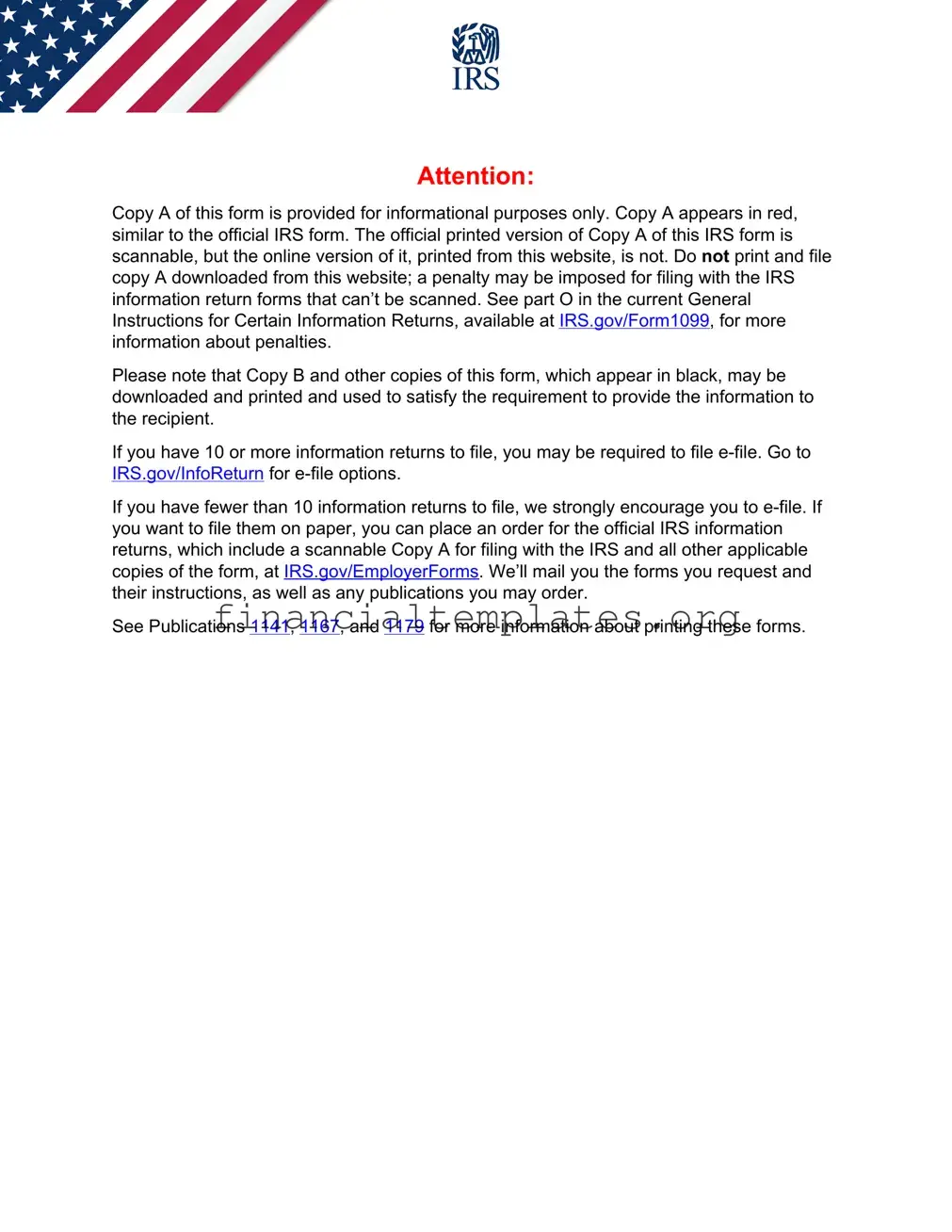
Attention:
Copy A of this form is provided for informational purposes only. Copy A appears in red, similar to the official IRS form. The official printed version of Copy A of this IRS form is scannable, but the online version of it, printed from this website, is not. Do not print and file copy A downloaded from this website; a penalty may be imposed for filing with the IRS information return forms that can’t be scanned. See part O in the current General Instructions for Certain Information Returns, available at IRS.gov/Form1099, for more information about penalties.
Please note that Copy B and other copies of this form, which appear in black, may be downloaded and printed and used to satisfy the requirement to provide the information to the recipient.
If you have 10 or more information returns to file, you may be required to file
If you have fewer than 10 information returns to file, we strongly encourage you to
See Publications 1141, 1167, and 1179 for more information about printing these forms.

9595 |
|
VOID |
CORRECTED |
|
|
|
|
|
|
|||
PAYER’S name, street address, city or town, state or province, country, ZIP |
1 |
Rents |
OMB No. |
|
|
|||||||
or foreign postal code, and telephone no. |
|
|
|
|
|
|
|
|
|
|||
|
|
|
|
$ |
|
Form |
|
Miscellaneous |
||||
|
|
|
|
2 |
Royalties |
(Rev. January 2024) |
|
Information |
||||
|
|
|
|
|
|
For calendar year |
|
|
||||
|
|
|
|
$ |
|
|
|
|
|
|
|
|
|
|
|
|
|
|
|
|
|
|
|
|
|
|
|
|
|
3 |
Other income |
4 |
Federal income tax withheld |
Copy A |
||||
|
|
|
|
$ |
|
$ |
|
|
|
|
For |
|
PAYER’S TIN |
RECIPIENT’S TIN |
|
5 |
Fishing boat proceeds |
6 |
Medical and health care |
Internal Revenue |
|||||
|
|
|
|
|
|
|
payments |
Service Center |
||||
|
|
|
|
|
|
|
||||||
|
|
|
|
|
|
|
|
|
|
|
|
|
|
|
|
|
$ |
|
$ |
|
|
|
|
File with Form 1096. |
|
RECIPIENT’S name |
|
|
7 |
Payer made direct sales |
8 |
Substitute payments in lieu |
For Privacy Act |
|||||
|
|
|
|
|
totaling $5,000 or more of |
|
of dividends or interest |
and Paperwork |
||||
|
|
|
|
|
consumer products to |
$ |
|
|
|
|
||
|
|
|
|
|
recipient for resale |
|
|
|
|
Reduction Act |
||
Street address (including apt. no.) |
|
|
9 |
Crop insurance proceeds |
10 |
Gross proceeds paid to an |
Notice, see the |
|||||
|
|
|
|
|
|
|
attorney |
current General |
||||
|
|
|
|
$ |
|
$ |
|
|
|
|
Instructions for |
|
|
|
|
|
|
|
|
|
|
Certain |
|||
City or town, state or province, country, and ZIP or foreign postal code |
11 |
Fish purchased for resale |
12 |
Section 409A deferrals |
||||||||
Information |
||||||||||||
|
|
|
|
|
|
|
|
|
|
|
||
|
|
|
|
$ |
|
$ |
|
|
|
|
Returns. |
|
|
|
|
|
|
|
|
|
|
|
|||
|
|
|
13 FATCA filing |
14 |
Excess golden parachute |
15 |
Nonqualified deferred |
|
||||
|
|
|
requirement |
|
payments |
|
compensation |
|
||||
|
|
|
|
$ |
|
$ |
|
|
|
|
|
|
Account number (see instructions) |
|
|
2nd TIN not. |
16 |
State tax withheld |
17 |
State/Payer’s state no. |
18 State income |
||||
|
|
|
|
$ |
|
|
|
|
|
|
$ |
|
|
|
|
|
$ |
|
|
|
|
|
|
$ |
|
Form |
Cat. No. 14425J |
www.irs.gov/Form1099MISC |
|
Department of the Treasury - Internal Revenue Service |
||||||||
Do Not Cut or Separate Forms on This Page — Do Not Cut or Separate Forms on This Page

|
VOID |
CORRECTED |
|
|
|
|
|
|
|
||
PAYER’S name, street address, city or town, state or province, country, ZIP |
1 |
Rents |
OMB No. |
|
|
|
|||||
or foreign postal code, and telephone no. |
|
|
|
|
|
|
|
|
|
|
|
|
|
|
$ |
|
Form |
|
Miscellaneous |
||||
|
|
|
2 |
Royalties |
(Rev. January 2024) |
|
|
Information |
|||
|
|
|
|
|
For calendar year |
|
|
|
|||
|
|
|
$ |
|
|
|
|
|
|
|
|
|
|
|
|
|
|
|
|
|
|
|
|
|
|
|
3 |
Other income |
4 |
Federal income tax withheld |
|
Copy 1 |
|||
|
|
|
$ |
|
$ |
|
|
|
|
|
For State Tax |
PAYER’S TIN |
RECIPIENT’S TIN |
|
5 |
Fishing boat proceeds |
6 |
Medical and health care |
|
Department |
|||
|
|
|
|
|
|
payments |
|
|
|||
|
|
|
$ |
|
$ |
|
|
|
|
|
|
RECIPIENT’S name |
|
|
7 |
Payer made direct sales |
8 |
Substitute payments in lieu |
|
|
|||
|
|
|
|
totaling $5,000 or more of |
|
of dividends or interest |
|
|
|||
|
|
|
|
consumer products to |
$ |
|
|
|
|
|
|
|
|
|
|
recipient for resale |
|
|
|
|
|
|
|
Street address (including apt. no.) |
|
|
9 |
Crop insurance proceeds |
10 |
Gross proceeds paid to an |
|
|
|||
|
|
|
|
|
|
attorney |
|
|
|||
|
|
|
$ |
|
$ |
|
|
|
|
|
|
City or town, state or province, country, and ZIP or foreign postal code |
11 |
Fish purchased for resale |
12 |
Section 409A deferrals |
|
|
|||||
|
|
|
$ |
|
$ |
|
|
|
|
|
|
|
|
13 FATCA filing |
14 |
Excess golden parachute |
15 |
Nonqualified deferred |
|
|
|||
|
|
requirement |
|
payments |
|
compensation |
|
|
|||
|
|
|
$ |
|
$ |
|
|
|
|
|
|
Account number (see instructions) |
|
|
16 |
State tax withheld |
17 |
State/Payer’s state no. |
|
18 State income |
|||
|
|
|
$ |
|
|
|
|
|
|
|
$ |
|
|
|
$ |
|
|
|
|
|
|
|
$ |
Form |
|
www.irs.gov/Form1099MISC |
|
Department of the Treasury - Internal Revenue Service |
|||||||


 CORRECTED (if checked)
PAYER’S name, street address, city or town, state or province, country, ZIP 1 Rents |
OMB No. |
or foreign postal code, and telephone no. |
|
|
|
|
$ |
Form |
Miscellaneous |
|||||
|
|
|
2 Royalties |
(Rev. January 2024) |
|
|
Information |
|||
|
|
|
|
For calendar year |
|
|
||||
|
|
|
$ |
|
|
|
|
|
|
|
|
|
|
|
|
|
|||||
|
|
|
3 Other income |
4 Federal income tax withheld |
Copy B |
|||||
|
|
|
$ |
$ |
|
|
|
|
|
For Recipient |
PAYER’S TIN |
RECIPIENT’S TIN |
5 Fishing boat proceeds |
6 |
Medical and health care |
|
|
||||
|
|
|
|
|
payments |
|
|
|||
|
|
|
$ |
$ |
|
|
|
|
|
|
RECIPIENT’S name |
|
|
7 Payer made direct sales |
8 |
Substitute payments in lieu |
|
This is important tax |
|||
|
|
|
totaling $5,000 or more of |
|
of dividends or interest |
|
||||
|
|
|
consumer products to |
$ |
|
|
|
|
|
information and is |
|
|
|
recipient for resale |
|
|
|
|
|
being furnished to |
|
Street address (including apt. no.) |
|
|
9 Crop insurance proceeds |
10 |
Gross proceeds paid to an |
|
the IRS. If you are |
|||
|
|
|
|
|
attorney |
|
required to file a |
|||
|
|
|
$ |
$ |
|
|
|
|
|
return, a negligence |
|
|
|
|
|
|
|
|
penalty or other |
||
City or town, state or province, country, and ZIP or foreign postal code |
11 Fish purchased for resale |
12 |
Section 409A deferrals |
|
sanction may be |
|||||
|
|
|
|
|
|
|
|
|
|
imposed on you if |
|
|
|
$ |
$ |
|
|
|
|
|
this income is |
|
|
|
|
|
|
|
|
taxable and the IRS |
||
|
|
13 FATCA filing 14 Excess golden parachute |
15 |
Nonqualified deferred |
|
determines that it |
||||
|
|
requirement |
payments |
|
compensation |
|
has not been |
|||
|
|
|
$ |
$ |
|
|
|
|
|
reported. |
|
|
|
|
|
|
|
|
|
||
Account number (see instructions) |
|
|
16 State tax withheld |
17 |
State/Payer’s state no. |
|
18 State income |
|||
|
|
|
$ |
|
|
|
|
|
|
$ |
|
|
|
$ |
|
|
|
|
|
|
$ |
Form |
(keep for your records) |
www.irs.gov/Form1099MISC |
|
Department of the Treasury - Internal Revenue Service |
||||||
Instructions for Recipient
Recipient’s taxpayer identification number (TIN). For your protection, this form may show only the last four digits of your social security number (SSN), individual taxpayer identification number (ITIN), adoption taxpayer identification number (ATIN), or employer identification number (EIN). However, the payer has reported your complete TIN to the IRS.
Account number. May show an account or other unique number the payer assigned to distinguish your account.
Amounts shown may be subject to
Form
Box 1. Report rents from real estate on Schedule E (Form 1040). However, report rents on Schedule C (Form 1040) if you provided significant services to the tenant, sold real estate as a business, or rented personal property as a business. See Pub. 527.
Box 2. Report royalties from oil, gas, or mineral properties; copyrights; and patents on Schedule E (Form 1040). However, report payments for a working interest as explained in the Schedule E (Form 1040) instructions. For royalties on timber, coal, and iron ore, see Pub. 544.
Box 3. Generally, report this amount on the “Other income” line of Schedule 1 (Form 1040) and identify the payment. The amount shown may be payments received as the beneficiary of a deceased employee, prizes, awards, taxable damages, Indian gaming profits, or other taxable income. See Pub. 525. If it is trade or business income, report this amount on Schedule C or F (Form 1040).
Box 4. Shows backup withholding or withholding on Indian gaming profits. Generally, a payer must backup withhold if you did not furnish your TIN. See Form
Box 5. Shows the amount paid to you as a fishing boat crew member by the operator, who considers you to be
Box 6. For individuals, report on Schedule C (Form 1040).
Box 7. If checked, consumer products totaling $5,000 or more were sold to you for resale, on a
Box 8. Shows substitute payments in lieu of dividends or
Box 9. Report this amount on Schedule F (Form 1040).
Box 10. Shows gross proceeds paid to an attorney in connection with legal services. Report only the taxable part as income on your return.
Box 11. Shows the amount of cash you received for the sale of fish if you are in the trade or business of catching fish.
Box 12. May show current year deferrals as a nonemployee under a nonqualified deferred compensation (NQDC) plan that is subject to the requirements of section 409A plus any earnings on current and prior year deferrals.
Box 13. If the FATCA filing requirement box is checked, the payer is reporting on this Form 1099 to satisfy its account reporting requirement under chapter 4 of the Internal Revenue Code. You may also have a filing requirement. See the Instructions for Form 8938.
Box 14. Shows your total compensation of excess golden parachute payments subject to a 20% excise tax. See your tax return instructions for where to report.
Box 15. Shows income as a nonemployee under an NQDC plan that does not meet the requirements of section 409A. Any amount included in box 12 that is currently taxable is also included in this box. Report this amount as income on your tax return. This income is also subject to a substantial additional tax to be reported on Form 1040,
Boxes
Future developments. For the latest information about developments related to Form
Free File Program. Go to www.irs.gov/FreeFile to see if you qualify for


 CORRECTED (if checked)
PAYER’S name, street address, city or town, state or province, country, ZIP 1 Rents |
OMB No. |
or foreign postal code, and telephone no. |
|
|
|
|
$ |
|
Form |
Miscellaneous |
|||||
|
|
|
2 Royalties |
|
(Rev. January 2024) |
|
|
Information |
|||
|
|
|
|
|
For calendar year |
|
|
||||
|
|
|
$ |
|
|
|
|
|
|
|
|
|
|
|
|
|
|
|
|
||||
|
|
|
3 Other income |
4 |
Federal income tax withheld |
|
Copy 2 |
||||
|
|
|
$ |
$ |
|
|
|
|
|
To be filed with |
|
PAYER’S TIN |
RECIPIENT’S TIN |
5 Fishing boat proceeds |
6 |
Medical and health care |
|
recipient’s state |
|||||
|
|
|
|
|
|
payments |
|
income tax return, |
|||
|
|
|
|
|
|
|
|
|
|
|
when required. |
|
|
|
$ |
$ |
|
|
|
|
|
|
|
RECIPIENT’S name |
|
|
7 Payer made direct sales |
8 |
Substitute payments in lieu |
|
|
||||
|
|
|
totaling $5,000 or more of |
|
|
of dividends or interest |
|
|
|||
|
|
|
consumer products to |
$ |
|
|
|
|
|
|
|
|
|
|
recipient for resale |
|
|
|
|
|
|
||
Street address (including apt. no.) |
|
|
9 Crop insurance proceeds |
10 |
Gross proceeds paid to an |
|
|
||||
|
|
|
|
|
|
attorney |
|
|
|||
|
|
|
$ |
$ |
|
|
|
|
|
|
|
City or town, state or province, country, and ZIP or foreign postal code |
11 Fish purchased for resale |
12 |
Section 409A deferrals |
|
|
||||||
|
|
|
$ |
$ |
|
|
|
|
|
|
|
|
|
13 FATCA filing 14 Excess golden parachute |
15 |
Nonqualified deferred |
|
|
|||||
|
|
requirement |
payments |
|
|
compensation |
|
|
|||
|
|
|
$ |
$ |
|
|
|
|
|
|
|
Account number (see instructions) |
|
|
16 State tax withheld |
17 |
State/Payer’s state no. |
|
18 State income |
||||
|
|
|
$ |
|
|
|
|
|
|
|
$ |
|
|
|
$ |
|
|
|
|
|
|
|
$ |
Form |
www.irs.gov/Form1099MISC |
|
|
Department of the Treasury - Internal Revenue Service |
|||||||
Document Specifics
| Fact Name | Description |
|---|---|
| Form Purpose | The IRS 1099-MISC form is used to report miscellaneous income, such as payments to independent contractors, rent, awards, and other non-employee compensation. |
| Filing Requirements | Generally, a 1099-MISC must be filed for each person to whom $600 or more has been paid during the year for services performed in a trade or business by a person not treated as employees. |
| Deadline | 1099-MISC forms must typically be sent to contractors by January 31st and filed with the IRS by February 28th if filing on paper, or by March 31st if filing electronically. |
| Penalties | Failure to file a 1099-MISC by the deadline can result in penalties from the IRS, which vary depending on how late the form is filed. |
| Electronic Filing | The IRS encourages electronic filing of the 1099-MISC forms through its FIRE (Filing Information Returns Electronically) system. |
| State Specifics | Some states have additional requirements or forms similar to the 1099-MISC. Compliance with state laws is necessary, and filers should consult their state’s department of revenue for specific rules. |
Guide to Writing IRS 1099-MISC
Filling out the IRS 1099-MISC form is an essential task for individuals and businesses that have made certain types of payments during the tax year. This document is crucial for reporting earnings not covered by traditional employment, making it fundamental for the IRS to accurately assess and collect taxes. The process, while straightforward, requires attention to detail to ensure all information is accurate and complete. The following steps are designed to guide you through this process efficiently, avoiding common mistakes and helping meet your tax obligations.
- Gather all required information: Before filling out the form, compile all necessary data, including the payer's (your) tax identification number (TIN), the recipient's name, address, TIN, and the total amount of payments made to the recipient during the year.
- Access the form: Download the latest version of the 1099-MISC form from the IRS website to ensure compliance with the current tax laws.
- Fill in payer information: In the upper left section of the form, input the payer's name, street address, city, state, zip code, and telephone number.
- Enter the payer’s TIN and recipient’s TIN: In the boxes provided, input your (payer's) TIN on the left and the recipient's TIN on the right.
- Add the recipient's information: Below the TIN boxes, fill in the recipient's name and address.
- Fill in the account number (if applicable): If you have multiple accounts for a recipient, enter the account number to differentiate the payments.
- Report the total amount paid: In Box 1 for rents or Box 7 for nonemployee compensation (depending on what you are reporting), enter the total amount you paid to the recipient during the tax year.
- Include any federal or state tax withheld: If you have withheld any taxes, report these amounts in the appropriate boxes.
- Review the form: Double-check all the information you have entered for accuracy and completeness. Errors can lead to processing delays and possible fines.
- Submit the form: Once completed, you will need to mail or electronically file the form with the IRS and send a copy to the recipient by January 31st of the following year.
Upon successful submission of the IRS 1099-MISC form, your next steps will depend on responses or additional requests from the IRS or the recipient. Be prepared to provide additional information or clarification if requested. Keeping a copy of the filed form and all relevant documents is crucial for your records and future reference. Timely and accurate completion of the 1099-MISC form is a significant compliance requirement, contributing to the smooth operation of your financial responsibilities.
Understanding IRS 1099-MISC
What is the IRS 1099-MISC form used for?
The IRS 1099-MISC form is utilized for reporting certain types of payments made in the course of a business or trade. These payments include but are not limited to, payments to independent contractors, rent, prizes and awards, and other income payments. This form helps the IRS track income that might not otherwise be reported.
Who needs to file a 1099-MISC form?
Business owners or individuals who have made certain payments totaling $600 or more during the year to a person who is not their employee are required to file a 1099-MISC form. This includes payments made to subcontractors, attorneys, and freelance workers. Non-profit organizations are also required to file if they meet these conditions.
What are the deadlines for filing the 1099-MISC form?
The 1099-MISC form must be sent to the recipient by January 31st following the tax year in which the payments were made. Additionally, the form must be filed with the IRS by January 31st if reporting non-employee compensation in box 7, or by February 28th if filing on paper, or March 31st if filing electronically, for all other types of payments.
What information is required to complete the 1099-MISC form?
When preparing a 1099-MISC form, you'll need to gather the recipient's name, address, and Taxpayer Identification Number (TIN), which can be a Social Security Number (SSN) or an Employer Identification Number (EIN). Additionally, the payer's information, including their TIN and the total amount of payments made during the tax year, is required. The nature of the payments must also be specified by checking the appropriate box on the form.
How can one obtain a 1099-MISC form?
The 1099-MISC form can be obtained from the Internal Revenue Service (IRS) website, through its ordering service for paper forms. Additionally, they can be found at office supply stores or through tax preparation software. It is important to note that the IRS requires the forms to be printed on specific red ink for paper filings, which may not be replicated by a standard printer.
Can the 1099-MISC be filed electronically?
Yes, the 1099-MISC forms can be filed electronically through the IRS Filing a Return Electronically (FIRE) system. It's often more convenient and reduces errors compared to paper filing. Additionally, businesses filing 250 or more 1099 forms must file them electronically, according to IRS regulations.
Are there penalties for not filing a 1099-MISC form?
Failure to file a 1099-MISC form or filing it late can result in penalties from the IRS. These penalties can vary depending on how late the form is filed and range from $50 to $280 per form, with a maximum of $1,130,500 per year for small businesses. The amount of the penalty increases the longer the delay in filing.
What should a recipient do if they receive a 1099-MISC form?
If an individual or business receives a 1099-MISC form, it means they have been paid for services or other transactions that must be reported as income when filing their tax return. Recipients should ensure that the information on the form matches their records. If there are discrepancies, they should contact the payer immediately to correct the information before filing a tax return.
How should payments to attorneys be reported?
Payments made to attorneys for legal services that total $600 or more during the year must be reported on the 1099-MISC form. This includes fees for services provided, not just settlements or awards. The payment should be reported in box 1 of the form.
Can a 1099-MISC be corrected after it has been filed?
If a mistake is discovered on a filed 1099-MISC form, it can be corrected. The payer must complete a new form, marking it as corrected at the top, and file it with the IRS. Additionally, the corrected form must be sent to the recipient. It is crucial to correct errors as soon as they are discovered to prevent IRS penalties.
Common mistakes
Filling out the IRS 1099-MISC form can be a daunting task. Individuals often encounter pitfalls that can lead to errors, potentially causing delays or financial repercussions. Here are six common mistakes to watch out for:
Not reporting all required income: Many make the mistake of not including all the income that needs to be reported on the 1099-MISC form. It's important to report every dollar to avoid penalties.
Incorrect taxpayer identification numbers (TIN): Inputting the wrong TIN, whether it's an SSN, EIN, or ITIN, is a frequent error. This mistake can lead to rejected forms or issues with income verification.
Failure to distribute copies appropriately: The filer must send copies of the 1099-MISC to the recipient, the IRS, and possibly the state tax department. Overlooking any of these can result in compliance issues.
Misclassifying workers: Erroneously classifying an employee as an independent contractor and vice versa can have significant tax implications and penalties.
Incorrect or incomplete information: Filling out the form with inaccurate information or leaving fields blank is a common mistake. Double-checking all entries for accuracy is crucial.
Missing the filing deadline: Submitting the 1099-MISC form late can lead to penalties. Being aware of the submission deadlines and planning accordingly is essential.
Avoiding these mistakes requires attention to detail and an understanding of the form's requirements. When in doubt, consulting with a tax professional can help ensure the process goes smoothly.
Documents used along the form
When dealing with tax documentation, particularly for independent contractors or freelance workers, the IRS 1099-MISC form is a crucial document. It reports the total amount of non-employee compensation. However, it often needs to be accompanied by other significant forms and documents to ensure a comprehensive and compliant tax filing process. The following list includes some of these important documents, each serving a unique purpose in the broader context of financial and tax management.
- W-9 Form - Request for Taxpayer Identification Number and Certification. Before issuing a 1099-MISC, companies should have this form on file. It collects the contractor’s correct taxpayer identification number (TIN) to report income to the IRS accurately.
- 1040 Form - U.S. Individual Income Tax Return. Independent contractors and freelancers use this form to file their annual income tax returns with the IRS, including all 1099-MISC income.
- Schedule C (Form 1040) - Profit or Loss from Business. This form is used by sole proprietors to report the income or loss from a business operated or a profession practiced as a sole proprietor.
- Schedule SE (Form 1040) - Self-Employment Tax. It calculates the self-employment tax owed on income from self-employment, including any income reported on a 1099-MISC form.
- 1099-NEC Form - Nonemployee Compensation. Starting in the tax year 2020, the IRS requires the use of this form to report nonemployee compensation previously reported in box 7 of the 1099-MISC.
- W-2 Form - Wage and Tax Statement. For individuals who are both employees and independent contractors for different companies, a W-2 form reports wages paid and taxes withheld by employers.
Successfully navigating the waters of tax filing and compliance requires more than just completing a single form. Each document plays a role in painting the full picture of an individual's financial landscape for the IRS. It is essential to understand these forms' purposes and ensure all necessary documents are accurately completed and submitted on time. This not only helps in avoiding penalties but also in harnessing potential tax benefits.
Similar forms
The IRS W-2 form shares similarities with the 1099-MISC form in that it reports income. However, the W-2 is specifically for employees whereas the 1099-MISC is for independent contractors and freelancers. Both forms are essential for tax reporting purposes, indicating the amount of money paid over the year and any taxes withheld. This distinction is crucial for understanding an individual's tax obligations and benefits.
The 1099-INT form, like the 1099-MISC, is part of the broader 1099 series and is used to report income. The key difference lies in the type of income reported; the 1099-INT form is specifically for reporting interest income. This can include interest from bank accounts, investments, and bonds. Although the income types are different, both forms serve the essential function of reporting income to the IRS and helping individuals accurately report their annual income.
Similar to the 1099-MISC form, the 1099-DIV reports income, but it is specifically for dividends and distributions. This form is used by corporations to report dividends paid to investors, including distributions from mutual funds or stock dividends. Both forms are crucial for investors and self-employed individuals, providing the necessary information to complete their tax returns and ensure correct reporting of their income and investments to the IRS.
The 1099-R form is another document in the 1099 series that reports distributions from pensions, annuities, retirement or profit-sharing plans, IRAs, and insurance contracts. It is analogous to the 1099-MISC in its role in reporting forms of income not tied to wages or salary. Individuals receiving retirement income must include this information in their tax filings, highlighting the importance of understanding the variety of 1099 forms for comprehensive income reporting.
The Schedule C (Form 1040) is utilized by sole proprietors to report profits or losses from their business operations, akin to how the 1099-MISC form reports income. While the 1099-MISC captures income from freelance or contract work, Schedule C encompasses a broader scope of business income and expenses. Both documents are integral for self-employed individuals, enabling the calculation of taxable income and presenting deductions that can reduce their tax liability.
Dos and Don'ts
Filling out the IRS 1099-MISC form correctly is important for both businesses and individuals to ensure compliance with the tax laws. Here are nine dos and don'ts to keep in mind when preparing this form:
- Do gather all necessary information, including the payee's name, address, and Taxpayer Identification Number (TIN), before filling out the form.
- Do make sure to accurately report the total amount paid to the individual or entity during the tax year in the appropriate box, depending on the type of payment.
- Do double-check that the form is for the correct tax year. IRS forms are updated annually, and using the wrong version can result in processing errors.
- Do use the official IRS 1099-MISC form or an IRS-approved version. Copies downloaded from the internet may not be accepted.
- Do send Copy A of the 1099-MISC form to the IRS and provide Copy B to the payee by the required deadlines to avoid penalties.
- Don't forget to report any federal or state tax withheld from the payee's earnings in the designated boxes on the form.
- Don't use the 1099-MISC form to report employee wages; the correct form for employee compensation is the W-2.
- Don't disregard the requirement to file electronically if you are submitting 250 or more 1099 forms. This helps in efficient processing and reduces errors.
- Don't miss the filing deadline, as late submissions can result in penalties. Consult the IRS website or tax advisor for the current year's due dates.
Misconceptions
Tax season brings with it a flurry of paperwork and confusion, particularly when it comes to 1099 forms. Understanding the IRS 1099-MISC form is crucial for both businesses and independent contractors. However, there are several misconceptions that need to be addressed to ensure compliance and avoid potential penalties.
- Only traditional employees receive tax forms. There's a common belief that tax forms are only for those in traditional employment. However, the IRS requires businesses to issue a 1099-MISC form to freelancers, independent contractors, and other non-employees who have been paid $600 or more for services during the tax year.
- Rental property income is not reported on a 1099-MISC. Some might think that rental income doesn't need to be reported on a 1099-MISC. In reality, if you receive rental income, the payer must report this to the IRS using a 1099-MISC form, provided the total amount paid to you is $600 or more in the year.
- Payments made electronically don’t need to be reported. There's a misconception that payments made via platforms like PayPal or credit cards are exempt from 1099-MISC reporting. These transactions are indeed reportable, but they are documented via Form 1099-K by the payment settlement entities, not on a 1099-MISC.
- All payments to corporations require a 1099-MISC. While many types of payments to individuals and non-corporate entities require a 1099-MISC, payments made to corporations typically do not. However, there are exceptions, such as medical, health care, and attorney fees, which must be reported even if the payments are made to corporations.
- Small businesses are exempt from issuing 1099-MISC forms. Every business, regardless of size, must comply with 1099-MISC reporting requirements for payments made in the course of their business activities. The size of the business does not exempt it from these requirements.
- Filing a 1099-MISC form is optional if the amount is under $600. Many believe that if payments to an individual or non-employee total less than $600 in a year, filing a 1099-MISC is optional. While it's true that you're not required to file a 1099-MISC for payments under $600 to any one entity, it’s a good practice to keep accurate records of all payments made, as they may be deductible business expenses.
Clearing up these misconceptions can save businesses and contractors time and money, ensuring that everyone stays on the right side of the IRS. Always consult with a tax professional to ensure compliance with current tax laws and regulations.
Key takeaways
Understanding how to correctly fill out and use the IRS 1099-MISC form is crucial for accurate tax reporting. This form is often used to report payments made in the course of a business or trade to people who aren't employees. Here are some key takeaways to keep in mind:
- The IRS 1099-MISC form is primarily for reporting payments of at least $600 in a year to individuals who are not your employees, such as independent contractors, attorneys, and other service providers.
- Payments made for rent, services, prizes and awards, medical and health care payments, crop insurance proceeds, cash payments for fish (or other aquatic life) you purchase from anyone engaged in the trade or business of catching fish, and payments to an attorney need to be reported using this form.
- It's important to collect a completed W-9 form from anyone you plan to issue a 1099-MISC. This will provide you with their correct taxpayer identification number (TIN) and address, helping prevent errors.
- The deadline to file the 1099-MISC form with the IRS varies depending on the method of filing. For paper filings, the deadline is typically February 28, while electronic filings must usually be submitted by March 31.
- Recipients of the 1099-MISC form should receive their copy by January 31, following the tax year in which the income was paid.
- If you fail to file a 1099-MISC form, you could face penalties ranging from $50 to $280 per form, depending on how late the form is filed. The maximum penalty can be up to $1,130,500 per year for small businesses.
- You do not need to file a 1099-MISC form for payments made for personal purposes. It is only required for business or trade payments.
- Electronic filing of the 1099-MISC form is encouraged by the IRS, especially if you are filing 250 or more forms. Filing electronically can be more efficient and can reduce the risk of errors.
- If you make a mistake on a 1099-MISC form, it is possible to correct it by filing a corrected form. Prompt correction of errors can help avoid penalties.
Accurate reporting using the IRS 1099-MISC form is a key component of compliance for businesses and individuals engaging in trade or business transactions. Keeping these key takeaways in mind can help ensure that this process is handled correctly.
Popular PDF Documents
IRS 1120-S - Facilitates S corporations in detailing their financial performance, crucial for accurate tax assessment and planning.
IRS Schedule K-1 1041 - It serves as a record-keeping tool, ensuring that all parties have the necessary documentation for legal and tax purposes.
Profits or Loss From Business - Facilitates the identification of tax-saving opportunities through allowable deductions.